
What Are the Best Ways for Kids to Build Critical Thinking When Using AI?
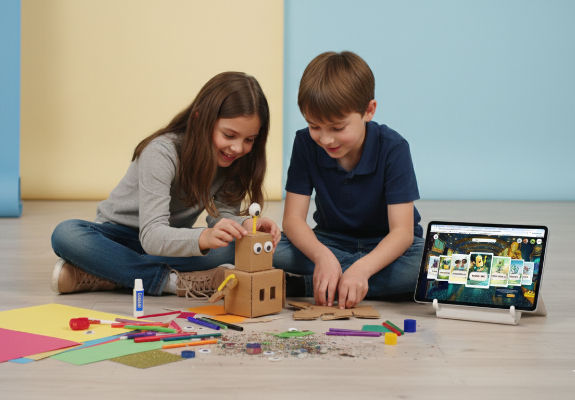
As AI becomes a normal part of homeschooling for kids, many parents worry that their child might start relying on AI too much. It’s a valid concern. AI can generate ideas, answer questions, and explain anything instantly — which means kids can skip the thinking that builds real intellectual strength.
But AI doesn’t have to weaken critical thinking. Used correctly, it can strengthen it.
Tools designed with learning science — like the best AI apps for homeschools — help kids question, analyze, compare, and reflect. AI becomes a thinking partner, not an answer machine.
Key Takeaways
Kids build critical thinking by interacting with AI, not copying it.
The right prompts push children to justify, explain, and evaluate ideas.
AI should help kids explore multiple perspectives, not replace effort.
Child-safe, structured AI tools are essential for guiding healthy use.
Writing, projects, and hands-on learning deepen AI-supported reasoning.
Why AI Can Strengthen Critical Thinking Instead of Replacing It
AI can make learning easier — but it can also make thinking deeper.Research shows children learn more when they compare ideas, evaluate options, and explain their reasoning. AI can make those opportunities happen more often.
This is why many families use AI tutors for kids: instead of giving answers, they ask guiding questions, encourage reflection, and prompt children to try again.
The result?More thinking, less guessing.
1. Let Kids Predict Before Asking AI
One of the strongest critical-thinking habits is prediction.
Before your child asks AI, prompt them:
“What do you think the answer is?”
“How would you begin solving this?”
“What’s your first guess?”
Prediction activates the brain’s reasoning networks. AI then becomes feedback, not a shortcut.
2. Teach Kids to Compare Their Thinking With AI’s Response
After AI gives an explanation, ask:
“How is this the same as what you thought?”
“How is it different?”
“Which explanation makes more sense?”
“How would you rephrase this in your own words?”
This teaches kids to evaluate — a higher-order thinking skill built into the AI curriculum for kids.
3. Use AI to Explore Multiple Perspectives
Critical thinking grows when kids see that problems rarely have one “right” angle.
Try prompts like:
“Give me three different ways to solve this.”
“Explain this from another viewpoint.”
“What might someone else think about this?”
Then discuss which approach your child thinks is strongest.
AI expands the perspective; the child chooses the reasoning.
4. Strengthen Critical Thinking Through Writing
Writing is one of the richest ways kids learn to analyze ideas.
Using AI writing feedback for kids, children learn to:
support claims
compare arguments
revise unclear thinking
identify gaps
strengthen logic
The key is that AI never writes for the child — it coaches them through better reasoning.
5. Use AI to Plan Projects, Not Complete Them
Hands-on projects are where critical thinking becomes visible.
AI projects for K–12 students give kids:
planning help
idea generation
step-by-step outlines
reflection prompts
But the child does the actual work: building, testing, creating, evaluating.
AI sparks the process.Kids drive the thinking.
6. Teach Kids to Question AI Instead of Obeying It
The most important skill in an AI-powered world is healthy skepticism.
Help your child ask:
“Does this seem accurate?”
“Where is the evidence?”
“Could AI be biased here?”
“What else should I check?”
This is central to AI literacy — and supported by the AI safety and ethics framework for students.
7. Model Slow, Reflective Thinking Yourself
Kids copy adult thinking patterns.
When you use AI:
question results
compare alternatives
explain your reasoning out loud
You teach your child how you think — and they mirror it.
FAQs
Q: Will AI harm my child’s critical thinking?
Not when it’s used in structured, guided ways. The wrong tools can encourage shortcuts, but well-designed educational AI strengthens reasoning.
Q: What age is appropriate for critical-thinking work with AI?
Ages 7–8 is generally a healthy starting point, as long as tools are scaffolded, safe, and parent-visible.
Q: How do I stop my child from using AI to avoid effort?
Require attempts first, reflections after, and use tools that provide feedback — not full solutions.
Q: Can AI actually make my child more analytical?
Yes. When kids compare, question, rewrite, and test AI’s output, they build deeper cognitive skills than if they worked alone.


