
How to Homeschool a Child with ADHD: 7 Strategies for an Effective ADHD Curriculum

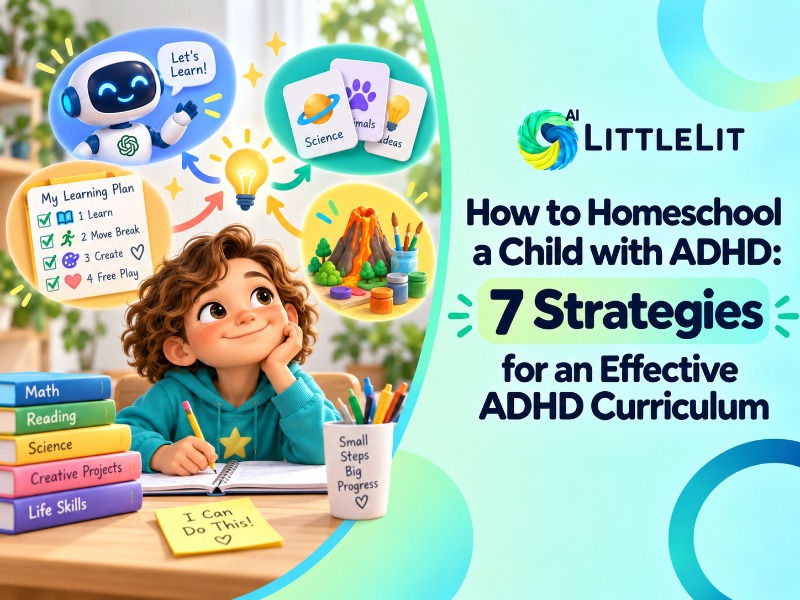
Many ADHD homeschool struggles start with a simple mismatch: a curriculum designed around a traditional classroom is brought home and expected to work the same way.
Long worksheets can quickly lose a child's attention.
Lesson plans may assume extended periods of sitting still. And advice like “just focus” does little to address the executive-function, working-memory, and attention challenges many children with ADHD experience.
Homeschooling gives families an opportunity to build something different.
Instead of forcing a child to fit the curriculum, parents can create an ADHD homeschool curriculum around shorter learning blocks, interactive teaching, flexible pacing, varied activities, movement, and targeted support.
Families looking for a curriculum designed around these needs can explore LittleLit’s homeschool curriculum for ADHD.
Below are seven practical strategies for homeschooling a child with ADHD and how LittleLit AI, an AI-powered K–12 curriculum, incorporates these ideas into the learning experience.
Table of Contents
How Long Should Homeschool Lessons Be for a Child with ADHD?
What Is Multisensory Learning and Why Does It Help Kids with ADHD?
How Can I Give My ADHD Child More Control Over Their Homeschool Day?
What Activities Work Best for Homeschooling a Child with ADHD?
How Do You Fix Learning Gaps for ADHD Kids Without Endless Repetition?
1. How Long Should Homeschool Lessons Be for a Child with ADHD?

Short answer: Keep lessons short and focused, and break larger learning objectives into individual skills your child can work through one at a time.
A child who struggles to sustain attention may find a long lesson overwhelming even when they understand the subject.
For example, instead of treating “understand main idea and supporting details” as one large task, you can break it into smaller skills:
Identify the topic sentence.
Distinguish a supporting detail from an opinion.
Find evidence that supports the main idea.
Summarize the main idea in one sentence.
This reduces how much information a child has to hold and process at once.
The important point isn't simply making the school day shorter. It's making each learning block clear, manageable, and focused on one achievable step at a time.
How LittleLit AI Does It
LittleLit’s scope and sequence breaks larger learning objectives into smaller units and individual skills.
Instead of handing a student an entire concept at once, the AI tutor can work through the skills step by step inside the lesson.
A lesson on identifying the main idea, for example, can move from recognizing a topic sentence to finding supporting details and then summarizing the idea.
The learning experience can move at the child's pace rather than requiring every student to spend exactly the same amount of time on a concept.

2. How Do You Keep an ADHD Child Engaged During a Lesson?

Short answer: Make learning interactive. Questions, short checks for understanding, conversation, and hands-on prompts give the child something to actively do rather than asking them to passively absorb information.
Passive learning can be particularly difficult for a child whose attention drifts easily.
Reading several pages of text or watching a long explanation requires sustained attention without much immediate participation. Interactive learning changes that rhythm.
A lesson might ask the child to:
answer a question,
make a prediction,
explain an idea,
solve a quick problem,
respond to a prompt, or
try the concept themselves.
The goal is to make the child a participant in the lesson, not simply a recipient of information.
How LittleLit AI Does It
LittleLit’s AI tutor uses a back-and-forth learning experience rather than relying only on static content.
The learning process can include questions, short quizzes, explanations, and “try it yourself” moments. Students can also ask the tutor questions while they are learning instead of waiting until the end of a lesson.
3.What Is Multisensory Learning and Why Does It Help Kids with ADHD?

Short answer: Multisensory learning combines different ways to receive and interact with information, such as text, visuals, audio, video, and interactive activities.
For some children with ADHD, spending an entire lesson reading dense text can make it difficult to stay engaged.
Changing how information is presented can give the learner more than one way to connect with the concept.
For example, a child learning a science concept might:
see a visual representation,
hear an explanation,
read a short piece of text,
answer an interactive question, and
apply the idea through an activity or project.
The point isn't to add stimulation for its own sake. It gives the child multiple pathways for understand and engage with the same concept.
How LittleLit AI Does It
LittleLit AI lessons can combine slides, audio narration, on-screen visuals, video, and interactive elements within the learning experience.
This gives students more variety than a lesson built entirely around reading a textbook or completing worksheets.
For families whose children have different learning needs, LittleLit AI also provides broader AI tools for special education, alongside dedicated homeschool curriculum options for ADHD, autism, dyslexia, and gifted learners.

4. How Should ADHD Kids Be Assessed in Homeschool?

Short answer: Don't rely on only one assessment format. Use different ways for a child to demonstrate what they understand.
A child may understand a concept but struggle to demonstrate that knowledge through a long written test.
Homeschooling gives parents more flexibility to use different forms of assessment, including:
quizzes,
verbal explanations,
flashcards,
projects,
demonstrations,
discussions, and
written responses.
Using more than one format can give parents a fuller picture of what the child actually understands.
How LittleLit AI Does It
LittleLit AI provides different ways for students to practice and demonstrate learning, including quizzes, flashcards, interaction with the AI tutor, and project-based activities.
Assessment can therefore be part of the learning process rather than one large test at the end.
LittleLit AI also connects learning with progress tracking, helping families see how a student is moving through skills rather than relying on a single test score.
5. How Can I Give My ADHD Child More Control Over Their Homeschool Day?

Short answer: Give your child structured choices while keeping the overall learning goals clear.
Choice doesn't have to mean letting a child skip everything they don't feel like doing.
Instead, parents can set boundaries and then let the child make decisions within them.
For example:
“Would you rather start with math or reading?”
“Do you want to write your answer or explain it aloud?”
“Would you rather complete the project before lunch or after your movement break?”
These small choices can give children more ownership without sacrificing curriculum coverage.
How LittleLit AI Does It
LittleLit AI uses choice-based learning experiences that give students more agency in how they move through parts of their learning.
Parents still remain involved in the homeschool plan, while students have opportunities to make choices and see their progress as they complete learning activities.
This balance between structure and flexibility is important when personalizing homeschooling for your child.
6. What Activities Work Best for Homeschooling a Child with ADHD?

Short answer: Build variety into the day. Combine academics with projects, creative work, hands-on learning, practical skills, and opportunities to move.
A homeschool day made entirely of worksheets can become repetitive quickly.
Instead, a child might move through:
Math → movement break → reading → creative writing → science project → lunch → life skills.
Homeschooling makes this kind of rhythm possible because families aren't tied to a classroom bell.
Short walks, stretching, outdoor time, building something, drawing, experimenting, or working on a practical task can all help break up periods of concentrated academic work.
How LittleLit AI Does It
Alongside core academics, LittleLit AI includes different kinds of learning experiences such as Creative Writing, Art, STEM projects, AI Missions, Financial Literacy, Science Labs, AI Literacy, and other enrichment activities.
That means a homeschool week can move between traditional academics and more applied learning rather than relying on one format all day.
Families can also incorporate practical learning through a life skills curriculum for kids and hands-on AI projects for K–12 students.
Because homeschool schedules are flexible, parents can still add movement, outdoor activities, and offline learning between structured lessons.
7. How Do You Fix Learning Gaps for ADHD Kids Without Endless Repetition?
Short answer: Identify the specific skill the child hasn't mastered and focus the re-teaching there instead of automatically repeating an entire unit.
Imagine a child understands most of a fractions unit but struggles with one particular skill.
Sending them back through every lesson they already understand can turn remediation into frustration.
A more targeted approach is:
Lesson & Practice → Assessment → Identify the Gap → Focused Gap Lesson → Continue
This keeps remediation focused on the missing skill.
How LittleLit AI Does It
LittleLit AI tracks learning at the skill level and connects lessons and practice with assessments and gap lessons.
When additional support is needed, the goal is to focus learning on the relevant gap rather than unnecessarily repeating material the student has already mastered.
Parents can also follow progress through LittleLit’s academic reporting and progress tools.
LittleLit AI Homeschool Plans and Pricing Options
Frequently Asked Questions
Q1.What is the best homeschool curriculum for kids with ADHD?
There isn't one curriculum that will be best for every child with ADHD. When comparing options, look for an ADHD homeschool curriculum that supports shorter, manageable learning blocks; breaks larger concepts into smaller skills; provides interactive learning; allows flexible pacing; includes varied activities; offers different ways to demonstrate mastery; and makes it easier to address individual learning gaps.
Q2.Can a child with ADHD be successfully homeschooled?
Yes. Homeschooling can give families considerably more control over pacing, lesson length, breaks, learning formats, and daily routines.The important question isn't simply whether a child has ADHD. It's whether the homeschool environment and curriculum are structured around how that individual child learns.
Q3.How many hours a day should you homeschool a child with ADHD?
No single number works for every child. Age, grade level, attention, learning needs, subjects, projects, and state requirements can all affect the length of the homeschool day. Instead of trying to reproduce a traditional six- or seven-hour classroom day at home, many families organize learning into focused blocks, with breaks and hands-on activities in between.
Q4.Does homeschooling help kids with ADHD academically?
It can, especially when homeschooling provides flexible pacing, shorter learning blocks, individualized support, varied activities, and targeted practice. Homeschooling itself doesn't guarantee better academic outcomes. The quality and fit of the curriculum, teaching approach, support, and learning environment still matter.
Q5.What is an AI homeschool curriculum, and how can it help ADHD learners?
An AI homeschool curriculum uses AI-supported learning tools to provide more personalized instruction, practice, feedback, or pacing. For a child with ADHD, that can be useful when it allows lessons to be broken into manageable steps, provides interactive support, and adjusts learning based on the student's progress. Parents who want to understand the broader approach can explore AI for homeschooling.
Q6.Is LittleLit AI a good fit for homeschooling a child with ADHD?
LittleLit AI is built around many of the strategies discussed in this guide: smaller, skill-based learning steps; interactive AI tutoring; varied learning formats; assessments; targeted gap lessons; projects; enrichment; flexible pacing; and progress tracking. It is part of LittleLit’s broader support for different learning needs, including dedicated resources for homeschooling autistic students, homeschooling students with dyslexia, and homeschooling gifted students.
Build an ADHD Homeschool Curriculum Around Your Child
An effective ADHD homeschool curriculum shouldn't require a child to spend the day fighting how they learn.
Shorter learning blocks, smaller skill steps, interactive teaching, varied activities, flexible assessment, meaningful choices, movement, and targeted support can make homeschooling more manageable for both children and parents.
The goal isn't to make learning easier by lowering expectations. It's to create a structure that gives a child a better opportunity to engage, practice, demonstrate what they know, and keep progressing.
LittleLit AI brings those pieces together within one AI-powered K–12 homeschool curriculum—while parents remain in control of their child's learning plan.
Ready to see it in action?
Explore the ADHD Curriculum | Start Your Free Trial


