STEM vs STEAM: What's the Difference and Which Is Better for Your Child?

STEM stands for Science, Technology, Engineering, and Mathematics, while STEAM adds Arts to the mix.
The main difference between STEM and STEAM is how creative subjects are included alongside science and technical learning.
If your child loves building things, solving puzzles, drawing, or telling stories, you may have wondered which approach suits them best. The good news is that STEM vs STEAM doesn't have to be an either-or choice.
Both approaches help children develop useful skills in different ways. In this guide, we'll compare STEM and STEAM education, explain their benefits, and share practical activities you can try at home.
Key Takeaways
STEM focuses on science, technology, engineering, and mathematics, while STEAM includes arts and design.
Both STEM and STEAM help children develop problem-solving, critical thinking, and practical skills.
STEM emphasizes scientific and technical learning, while STEAM integrates creativity and artistic expression.
Children can begin STEM and STEAM activities at an early age, with projects suited to their abilities.
Parents can introduce STEM and STEAM at home through simple experiments, coding, building projects, and storytelling.
LittleLit AI supports STEM and STEAM learning through AI-powered educational and creative activities.
Table of Contents
What Is the Difference Between STEM and STEAM?
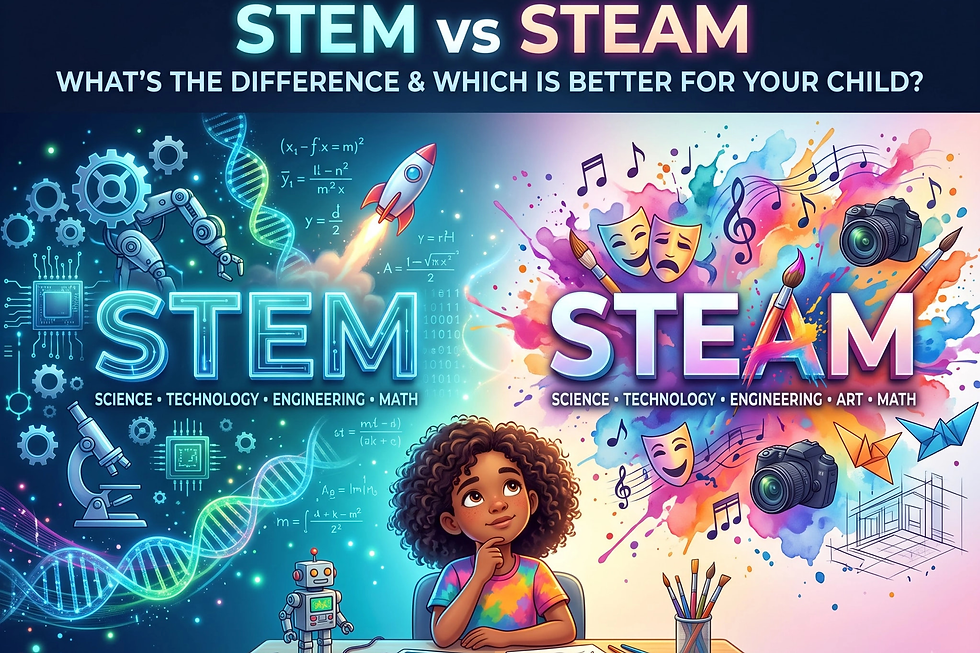
The main difference between STEM and STEAM is the inclusion of arts.
STEM focuses on science, technology, engineering, and mathematics, while STEAM brings creative subjects into the learning process.
Both develop problem-solving and critical thinking skills, but STEAM places additional emphasis on artistic expression, design, and creative thinking.
According to the Rhode Island School of Design (RISD), which helped popularize STEAM education, adding art and design to STEM encourages students to connect creative thinking with science, technology, engineering, and mathematics.
STEM vs STEAM: Key Differences
Comparison | STEM Education | STEAM Education |
Full Form | Science, Technology, Engineering, Mathematics | Science, Technology, Engineering, Arts, Mathematics |
Focus | Scientific inquiry, technical skills, and problem-solving | Combines scientific and technical learning with arts and design |
Skills Built | Logical thinking, coding, analysis, and engineering | Creative thinking, design, communication, and technical skills |
Example Activity | Building a bridge using blocks and testing its strength | Building a bridge, testing its strength, and designing its appearance |
Best Suited For | Children interested in numbers, experiments, technology, and building | Children who enjoy combining science with drawing, storytelling, music, or design |

For parents: STEM and STEAM are closely connected. A child can enjoy coding and painting, or love mathematics and storytelling. The right approach depends on their interests and the skills they want to develop.
What Is STEM Education?

STEM education is a learning approach that brings together Science, Technology, Engineering, and Mathematics.
Instead of studying these subjects separately, children learn how to use them together to solve real-world problems.
The term STEM became widely used in the early 2000s, following efforts by the U.S. National Science Foundation (NSF) to strengthen science and technology education.
For example, a child building a paper bridge might measure its length, test how much weight it can hold, and figure out why it bends or collapses. This single activity brings engineering, mathematics, and scientific thinking together.
The U.S. National Science Foundation (NSF) supports STEM education and research, with a focus on building scientific knowledge, technical skills, and problem-solving abilities.
STEM education helps children develop skills such as:
Problem-solving: Finding solutions through experiments and trial and error. Parents can also encourage problem-solving skills through guided AI activities.
Critical thinking: Asking questions, examining evidence, and drawing conclusions.
Logical reasoning: Understanding patterns, numbers, and relationships.
Technical skills: Learning the basics of coding, engineering, and technology.
Teamwork: Sharing ideas, testing solutions, and working with others.
STEM learning can begin with simple activities like sorting objects, building with blocks, or observing plants. Children can develop these skills long before they start learning advanced science or mathematics.
LittleLit AI Homeschool Plans and Pricing Options
LittleLit AI offers homeschool plans that bring STEM, STEAM, and AI-powered learning into one platform. Families can choose a plan based on their child's learning needs and access structured lessons, creative projects, and educational activities.
What Is STEAM Education?

STEAM education combines Science, Technology, Engineering, Arts, and Mathematics to help children approach problems from different angles.
It brings creative activities such as drawing, designing, and storytelling into science and technology lessons.
Imagine a child building a model of a solar-powered house. They learn how solar panels work, calculate measurements, and choose materials.
Then they sketch the layout, design the rooms, and explain their ideas through a presentation.
This is STEAM education in action. Children use scientific knowledge and creativity together to complete a project.
What Does the "A" in STEAM Stand For?
The A in STEAM stands for Arts, which includes much more than painting or drawing. It can involve several creative subjects:
Visual Arts: Drawing, painting, illustration, and creating models.
Design: Planning how a product looks, feels, and functions.
Music: Studying sound, rhythm, patterns, and musical composition.
Drama: Acting out scientific concepts or presenting ideas through role-play.
Writing: Using storytelling and creative writing to explain scientific ideas.
For example, children might study the water cycle and then create a comic strip showing how a raindrop travels through evaporation, condensation, and precipitation.
These activities show how STEM vs STEAM education can overlap. Both involve scientific thinking, while STEAM deliberately brings artistic methods into the learning experience.
Benefits of STEM vs Benefits of STEAM

Both STEM and STEAM help children develop problem-solving skills, curiosity, and confidence through hands-on learning.
STEM places greater emphasis on scientific and technical applications, while STEAM explicitly integrates arts and design into those activities.
Here's how their benefits compare:
Benefits | STEM Education | STEAM Education |
Problem-Solving | Encourages testing, experimentation, and logical reasoning. | Combines experimentation with creative approaches to solving problems. |
Critical Thinking | Helps children analyze evidence, patterns, and results. | Helps children evaluate ideas from scientific and creative perspectives. |
Creativity | Encourages invention, experimentation, and technical innovation. | Explicitly incorporates artistic expression, imagination, and design. |
Technical Skills | Develops coding, mathematics, engineering, and scientific skills. | Applies technical skills alongside art, design, and creative projects. |
Communication | Builds skills through teamwork, scientific explanations, and presentations. | Adds opportunities to communicate through visual art, storytelling, and performance. |
Real-World Applications | Introduces practical challenges involving science and technology. | Connects technical solutions with design, communication, and human experiences. |
Can Children Benefit From Both STEM and STEAM?
Children can develop scientific thinking and creativity through the same activity.
For example, a child might build a working model of a wind turbine model, measure how much electricity it generates, and then design an illustrated poster explaining the results.
Parents can encourage critical thinking with AI by asking children to evaluate their ideas and explain their decisions.
STEM provides the scientific and technical foundation, while STEAM explicitly incorporates creative expression into the project.
Children interested in combining technology with art can also try AI-powered creativity activities for kids, including digital storytelling and visual design.
For parents: The best approach is to give children opportunities to experiment, build, design, and express their ideas.
Their interests can guide which activities you introduce first.
Which Is Better for Your Child? A Simple Parent Guide

Choosing between STEM vs STEAM for kids depends on your child's interests and how they enjoy learning.
Some children love solving puzzles and building machines, while others prefer drawing, storytelling, or designing things. Many enjoy both.
Here's a quick guide to help you choose activities your child might enjoy.
If Your Child Enjoys... | Start With | Activity to Try |
Building LEGO models, robots, or machines | STEM | Build a bridge and test its strength. |
Numbers, puzzles, and logical challenges | STEM | Solve number patterns or create a secret code. |
Drawing, painting, and designing | STEAM | Design and build a model house. |
Storytelling and creative writing | STEAM | Write and illustrate a science story. |
Music, rhythm, and sound | STEAM | Make a musical instrument and study sound vibrations. |
Both science and creativity | STEM + STEAM | Code an animated science story. |

What If Your Child Enjoys Both?
That's perfectly normal. A child who loves mathematics may also enjoy music, while someone interested in art might become fascinated by robotics.
Try different activities and observe what keeps your child interested. Children who enjoy complex challenges may also benefit from a homeschool curriculum for gifted learners that supports deeper learning.
Parent Tip: Start with your child's interests, but introduce both STEM and STEAM activities over time. Their preferences can change as they grow, and both approaches have valuable skills to teach.
STEM and STEAM by Age Group

Children can begin STEM and STEAM learning at any age. The activities simply need to match their interests and abilities. Younger children learn through play, while older students can take on projects involving experiments, coding, and design.
Early Elementary (Grades K–2)
At this age, hands-on activities help children understand basic concepts like shapes, counting, balance, and patterns. Building blocks, drawing, and simple experiments are good starting points.
Activity: Build a tower using paper cups, count how many it takes, and decorate it with different shapes and colors.
Parents following an elementary homeschool curriculum can include similar activities in everyday lessons.
Upper Elementary (Grades 3–5)
Children can begin testing ideas, recording observations, and explaining their results. Projects that combine measurement, engineering, and creativity work particularly well.
Activity: Build a paper bridge, test how many coins it can hold, and redesign it to improve its strength. Then sketch the final design and explain what changed.
Middle School (Grades 6–8)
Middle school students can handle more detailed experiments, basic programming, and independent projects. Encourage them to research problems, compare solutions, and present their findings.
Activity: Code a short animation showing how the water cycle works, using scientific explanations, illustrations, and narration.
Families using a middle school homeschool curriculum can connect these projects with science, mathematics, and technology lessons.
How to Teach STEM and STEAM at Home

You don't need expensive science kits or a dedicated lab for STEAM learning at home.
Everyday materials like paper, cardboard, cups, and recycled containers are enough to introduce children to science, engineering, mathematics, and creative thinking.
Parents can also turn everyday activities into opportunities for hands-on learning.
Here are six simple STEAM activities for kids that homeschool families can try.
Build and Design a Bridge: Use paper, straws, or cardboard to build a bridge. Test how many coins it can hold, then improve its structure and decorate the finished model.
Create a Coding Animation: Use a beginner-friendly coding tool like Scratch to animate a character moving through space. For more digital activities, try these AI projects for K–12 students that combine technology with creative problem-solving.
Write and Illustrate a Science Story: Choose a topic like the solar system or plant growth. Research the facts, write a short story, and draw pictures to explain the science.
Make a Homemade Musical Instrument: Fill glasses with different amounts of water and gently tap them with a spoon. Compare the sounds and discuss how vibrations produce different pitches.
Design a Mini Garden: Plant seeds in recycled containers, measure their growth, and record the results. Draw a garden layout and create labels for each plant.
Build a Balloon-Powered Car: Use cardboard, bottle caps, straws, and a balloon to build a small car. Measure how far it travels, test different designs, and decorate it.

Where AI Fits Into STEM and STEAM Learning
AI gives children another way to experiment, solve problems, and express their ideas. In STEM, students can use AI to examine data, recognize patterns, and get help understanding coding concepts. In STEAM, they can use it to create illustrations, compose music, and develop stories.
Here are a few ways AI can support both approaches:
STEM – Coding and Problem-Solving: Children can use AI to understand coding errors, compare solutions, and learn how simple programs work.
STEM – Science and Data: Students can record plant growth or weather observations and use AI to organize the results into tables and charts.
STEAM – Art and Design: Children can experiment with AI art generators for kids to turn their ideas into illustrations and learn about visual design.
STEAM – Music and Storytelling: Students can write lyrics, experiment with AI-generated melodies, or develop characters and stories using an AI-powered writing curriculum.
LittleLit AI brings these experiences together through its AI curriculum for kids, where children can learn about AI while working on creative and technical projects.
Parents should encourage children to question AI-generated answers, check scientific facts, and contribute their own ideas.
Teaching children to fact-check AI helps them develop stronger research and evaluation skills. Teaching responsible AI use for students is just as important as learning how to use the tools.
Why Choose LittleLit AI for STEM and STEAM Learning?
LittleLit AI brings STEM and STEAM education together through AI-powered lessons, hands-on projects, and creative activities. Children can develop skills in science, technology, engineering, mathematics, and the arts while learning how to use AI responsibly.
Here's why parents choose LittleLit AI:
STEM and STEAM Learning: Build problem-solving, coding, scientific thinking, and creative skills through engaging activities.
Creativity Through AI: Encourage children to experiment with digital art, storytelling, music, and design alongside technical subjects.
WASC Accreditation: LittleLit AI is WASC-accredited, giving families confidence in its educational standards.
Homeschool-Friendly Curriculum: Access structured learning activities that fit into daily homeschool schedules.
Responsible AI Education: Help children understand AI tools, evaluate their outputs, and use technology thoughtfully.
Ready to introduce your child to STEM and STEAM? Start your free trial with LittleLit AI and bring science, technology, and creativity into everyday learning.

Final Thoughts: STEM or STEAM, Which Should You Choose?
When comparing STEM vs STEAM, the best choice depends on your child's interests, learning style, and goals. Both approaches build problem-solving, critical thinking, and practical skills. STEM focuses on scientific and technical subjects, while STEAM brings art, design, and creative expression into the learning experience.
You can introduce both through simple projects, experiments, coding, and storytelling. Pay attention to the activities your child enjoys and encourage them to try something new.
Help your child learn, create, and grow with LittleLit AI.
Frequently Asked Questions
Q1. What is the main difference between STEM and STEAM?
The main difference between STEM and STEAM is that STEAM explicitly includes arts alongside science, technology, engineering, and mathematics. STEM emphasizes scientific and technical learning, while STEAM integrates creative subjects such as art, music, writing, and design.
Q2. What does the A in STEAM stand for?
The A in STEAM stands for Arts. This includes visual arts, design, music, drama, and creative writing. Arts integration helps children use creative expression alongside scientific and technical skills.
Q3. Is STEAM better than STEM?
No, STEAM is not automatically better than STEM. Both approaches develop valuable skills. STEM emphasizes scientific investigation and technical problem-solving, while STEAM explicitly incorporates arts and design. Most children benefit from experiencing both.
Q4. At what age should kids start learning STEM or STEAM learning?
Children can start STEM and STEAM learning as early as preschool. Simple activities such as stacking blocks, sorting shapes, drawing patterns, and observing plants introduce early scientific and creative concepts. Parents can gradually introduce more challenging activities as children grow, including projects from a fifth-grade homeschool curriculum.
Q5. Can you do STEAM learning at home?
Yes, you can do STEAM learning at home can be done with everyday materials. Children can build paper bridges, grow plants, create musical instruments, or write illustrated science stories. Families following a homeschool learning program can include these activities alongside their regular science, mathematics, and creative lessons.
Q6. Is coding part of STEM or STEAM?
Coding is part of both STEM and STEAM. In STEM, children might write programs to solve mathematical problems or control robots. In STEAM, they can use coding to create animations, interactive stories, games, or digital artwork.
MEET AUTHOR

Dipti Bhide
Co-Founder & CEO, LittleLit AI
Dipti Bhide is the Co-Founder & CEO of LittleLit AI, a 2X founder, AI product expert, and certified instructional designer. She writes about AI for kids, personalized learning, homeschooling, and responsible AI in education.